

AISH vs ADAP: What Deaf and DeafBlind Albertans Need to Know

A Letter in the Mail
Imagine opening a government letter. It says you are no longer on AISH. You are now on something called ADAP. The letter says you are "able to work."
But you know your reality. You are Deaf. Job interviews happen without interpreters. Employers do not call back. Your health has good days and bad days.
This summer, thousands of Albertans got news like this. Many people in our Deaf community are upset, confused, and scared. This post explains what AISH and ADAP mean, what changed, and why Deaf and DeafBlind people need to speak up now.
What Is AISH?
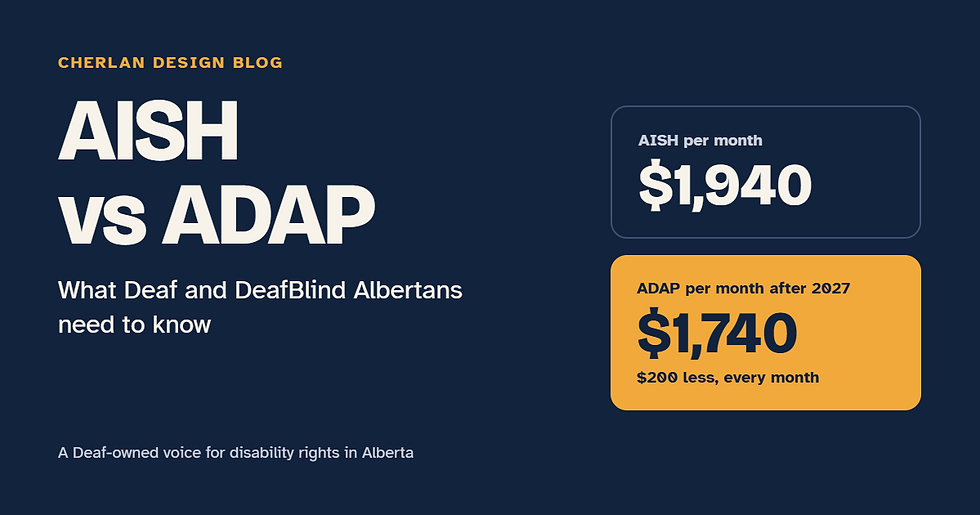
AISH means Assured Income for the Severely Handicapped. It is Alberta's monthly income support for adults with a severe, permanent disability. In 2026, the most a single person can get is $1,940 per month (Inclusion Alberta).
Since July 2026, AISH is only for people the government says are permanently unable to work. The rules for working also got stricter. On AISH now, you can earn only $350 per month before your benefit goes down, dollar for dollar. Before July, that amount was $1,072 (Gillian Petit, University of Calgary).
What Is ADAP?
ADAP means Alberta Disability Assistance Program. It started in July 2026. It is for adults with a severe disability whom the government decides can work at least some of the time (CBC News).
The ADAP benefit is $1,740 per month, which is $200 less than AISH. Most AISH clients were moved to ADAP automatically on July 1. People who were moved get a $200 "transition benefit" until December 31, 2027. After that, their payment drops (Alberta Medical Association).
Some groups were not moved automatically: people aged 60 or older, people in continuing care, people with a terminal illness, and people with a severe or profound developmental disability.
The government says ADAP helps people who can work. The minister said AISH supports "fall short" for disabled people who can work (CBC News). On ADAP, a single person can earn $700 per month before benefits go down (Yahoo News).
New in October 2026: After strong public pushback, Alberta reversed some changes. It restored full benefits for couples where both partners get AISH or ADAP, with back pay. It also made it simpler to apply to move from ADAP back to AISH (CBC News).
AISH vs ADAP at a Glance
AISH (since July 2026) | ADAP | |
Who it is for | People assessed as permanently unable to work | People assessed as able to do some work |
Monthly benefit (single) | $1,940 | $1,740 ($1,940 with transition benefit until Dec 31, 2027) |
Earn before benefit drops (single) | $350/month | $700/month |
Health benefits (drugs, dental, optical) | Yes | Yes, expected to stay the same |
Canada Disability Benefit | Clawed back by Alberta | Clawed back by Alberta |
Sources: Inclusion Alberta, Gillian Petit, Quiet Canines.
What If Your Health Means You Cannot Work?
This is the biggest fear we hear. Many people have long-term health problems on top of being Deaf. Some days, working is simply not possible.
Here is what you should know:
You can ask to move back to AISH. If you were moved to ADAP but cannot work, you can be assessed for AISH. In October 2026, Alberta said it made this application simpler (CBC News).
Do it before December 31, 2027. After the transition benefit ends, staying on ADAP means $200 less every month.
Your doctor's support matters. Ask your doctor to describe clearly how your health affects your ability to work.
ADAP decisions can be appealed. If you disagree, you have the right to appeal (Inclusion Alberta).
Doctors are worried too. The Alberta Medical Association called the reassessments punitive and said they waste health-care time (Alberta Medical Association). One AISH client told CBC she does not understand how the government can decide she is well enough to work when her doctor says she is not (CBC News).
No one should be pushed into work their body cannot handle. Being "able to work a little" is not the same as being able to find a job that pays the rent.
The Human Cost: Real Stories
Content note: this section talks about suicide and depression. If you are struggling, please see the support information at the end of this section.
These changes are not only about money. For many people, they are about stress, fear, and mental health.
Bruce Johnson, 57, of Empress, Alberta. Bruce had been on disability support for 29 years. He lived with depression and anxiety since he was 10 years old. In June 2026, he died by suicide. In a final message, he wrote that the coming move to ADAP made his anxiety, stress, and depression much worse. He feared he would be forced into job searches he could not manage (Global News, CTV News).
Scott Ganley. Scott was on AISH and was told he would be moved to ADAP. A friend said the news was frightening for him from the start. His disappearance and suspected suicide led to a public vigil in September 2026 for both men (CBC News).
Families watching loved ones struggle. Terri Grills has two adult children on AISH. Neither can work, and both have had mental health struggles because of the move to ADAP. She told CBC that watching them suffer has broken her family's hearts (CBC News).
People who cannot work. Crystal Lena of Red Deer lives with depression and anxiety. She said her ADAP letter left her upset, worried, and overwhelmed because she is unable to work (rdnewsnow).
Disability advocate Heather Fairbairn says more and more people in online support groups talk about feeling hopeless because of the changes (Yahoo News Canada). The government has said every life lost to suicide is a tragedy, and that help is available (CBC News).
One life lost is too many. Policy changes must protect people's mental health, not put it at risk.
If You Are Struggling, You Are Not Alone
Call or text 9-8-8 any time, 24/7. Texting works well for Deaf and hard-of-hearing people. You can also call through Video Relay Service (VRS).
Call 211 in Alberta to find mental health support, including same-day counselling.
In an emergency, call or text 9-1-1.
Reach out to someone you trust: a friend, family member, or your Deaf community.
There are people who want to help you get through this. Your life matters.
Why This Hits Deaf and DeafBlind People Harder
ADAP assumes a job is out there for anyone who can work. For Deaf people, that is often not true.
Jobs are hard to get. The Canadian Association of the Deaf has said about 40% of Deaf Canadians are not working, and many more have unstable jobs (CBC News). That number has stayed high for decades.
Pay is low. The CAD reports very few Deaf Canadians in professional or senior jobs. Many Deaf workers end up in low-paid work or small home businesses (Canadian Association of the Deaf).
The math is hard. University of Calgary researcher Gillian Petit found that a person earning under about $2,114 a month gets less on ADAP than on the old AISH (CBC News). Inclusion Alberta says that means working about 33 to 34 hours a week at minimum wage just to come out ahead.
Rent and bills keep rising. Inclusion Alberta notes that Calgary now has one of the highest costs of living in Canada (Inclusion Alberta fact sheet). Since October 2025, rent in community housing counts all AISH income, so many people now pay more rent (Alberta Medical Association).
Alberta has no accessibility law. There is no provincial law that makes employers create accessible workplaces (CBC News). Without interpreters, captioning, and Deaf-aware employers, "able to work" means little.
DeafBlind people face even more. DeafBlind people need intervenors, trained support workers who act as their eyes and ears. There is no federal funding for intervenor services, and Alberta's services are limited (Canadian Council of the Blind). Ontario, Saskatchewan, and B.C. fund dedicated DeafBlind services; Alberta does not (CNIB).
Many successful Deaf adults had strong family support, often hearing parents who could pay for tutors, advocates, and connections. That support is rare. A fair system should not depend on luck.
Pros and Cons
Pros | Cons | |
AISH | Higher monthly benefit ($1,940); meant for people who cannot work; no pressure to find a job | Must be assessed as permanently unable to work; only $350/month earnings allowed, then 100% clawback; harder to try part-time work |
ADAP | Can earn $700/month before benefits drop; option to try work; same health benefits; transition top-up until end of 2027 | $200/month less after 2027; assumes jobs exist; no accessibility law for employers; risk of deeper poverty if you can't find enough work |
To be fair, the government says ADAP rewards people who work, and that Alberta still has the highest disability benefit rate in Canada (CTV News). Critics answer that a higher earnings limit does not create accessible jobs (Yahoo News). Alberta is also the only province that claws back the federal Canada Disability Benefit (Refdesk).
Dreaming of Your Own Business
Many Deaf people dream of running their own business. For many of us, it is the most realistic path, because hearing workplaces shut us out. But it is harder for us. We often have less money to start, fewer business contacts, and must pay for interpreters ourselves.
There is some help:
Entrepreneurs with Disabilities Program (EDP): Business advice, training, mentoring, and loans for people with disabilities in Western Canada. The federal government renewed it for five years in June 2026 (PrairiesCan). In Alberta, contact your local Community Futures office.
Opportunities Fund for Persons with Disabilities: A federal fund that pays community groups to run job and business programs (Saint Mary's University).
Support for women entrepreneurs: In February 2026, Ottawa funded a national project on women entrepreneurs with disabilities (Women and Gender Equality Canada).
But there are gaps. Most programs offer loans, not grants. Few budget for ASL interpreters. Business income can also reduce AISH or ADAP payments. Deaf entrepreneurs need start-up grants, interpreter funding, and earnings rules that let a small business grow.
What Governments Across Canada Should Do
Disability support is different in every province. B.C. and Ontario fully let people keep the federal Canada Disability Benefit; Alberta does not (Immigration News Canada, Refdesk). Deaf and DeafBlind Canadians should get fair support no matter where they live.
Here is what we are asking for:
Stop the Canada Disability Benefit clawback in Alberta, so the federal money reaches disabled people.
Keep the $200 top-up past 2027, or raise ADAP to match AISH.
Pass an accessibility law in Alberta that requires employers to provide interpreters and captioning.
Fund DeafBlind intervenor services in Alberta and every province, like Ontario, Saskatchewan, and B.C. do.
Fund Deaf-led employment programs with ASL-fluent job coaches.
Offer start-up grants for Deaf and disabled entrepreneurs, including money for interpreters.
Consult the Deaf community in ASL before making changes. Inclusion Alberta says disability groups were not meaningfully consulted on ADAP (Inclusion Alberta).
The October reversal shows that speaking up works. The government changed course after hearing from the community (CTV News). Our voices matter.
Practical Tips
Check your letter. Find out if you are on AISH or ADAP right now.
Ask for an interpreter. You have the right to communicate clearly with your caseworker. Ask for ASL interpretation or written communication.
Talk to your doctor early. If you cannot work, get medical notes that explain why.
Apply to return to AISH before December 31, 2027 if you believe you belong there.
Keep copies of everything: letters, forms, and emails.
Get help. Inclusion Alberta, your local Deaf organization, or a disability advocate can help you fill out forms or appeal.
Tell your story. Write to your MLA. Share your experience on social media in ASL. The October changes happened because people spoke up.
This post is for information only and is not legal or financial advice. Rules can change, so check with Alberta's AISH/ADAP office for your situation.
Sources
Alberta restores benefits for couples, simplifies return to AISH — CBC News, Oct 2026
Alberta takes U-turn on disability benefit changes — CTV News, Oct 2026
ADAP and AISH: Benefit Levels for Single Adults — Gillian Petit
Understanding the changes to AISH and ADAP — Inclusion Alberta
Employment and Employability — Canadian Association of the Deaf
Intervenor services for the DeafBlind community — Canadian Council of the Blind
Entrepreneurs with Disabilities Program renewed — PrairiesCan, June 2026


Comments